Player Pool Composition and Its Influence on Expected Value in Multi-Game Card Settings
Written by Jonas Lang · Sep 15, 2026

Player Pool Composition and Its Influence on Expected Value in Multi-Game Card Settings
Player pool composition refers to the mix of skill levels, playing styles, and experience that participants bring to environments where multiple card games operate alongside one another, and researchers have documented measurable effects on expected value calculations across these blended settings. Data from regulated North American venues shows that tables with higher proportions of recreational participants often produce different variance patterns compared to those dominated by experienced regulars, while studies from the University of Nevada Reno indicate that demographic factors such as age distribution and session length further modify individual outcomes in combined poker and table game areas.
Analysts tracking venue-level statistics note that when a pool contains a greater share of infrequent visitors, the frequency of suboptimal decisions rises in games like blackjack variants and draw poker hybrids, which in turn shifts the collective expected value distribution for all participants at the table. Observers have recorded similar patterns in Australian casino reports where tourist-heavy periods correlate with elevated volatility in side bet participation rates, and these shifts appear consistently across multiple jurisdictions without requiring subjective interpretation of intent.
Key Variables in Pool Composition
Skill stratification within a player pool affects decision trees in real time because participants adjust their ranges and bet sizing based on observed tendencies from others at the table, and quantitative models developed by gaming research institutes demonstrate that a 20 percent increase in novice players can alter equity realization percentages by several points in multi-way pots. Casino operators in Canadian provinces have compiled internal datasets showing that pools weighted toward locals versus transient visitors produce distinct hand volume metrics, with the former group tending toward tighter preflop selections while the latter group exhibits broader calling ranges that influence pot odds for everyone involved.
Geographic origin also plays a documented role, since data aggregated by European gaming associations reveals that players from regions with different regulatory histories approach blended environments with varying familiarity levels regarding rule variations and payout structures. This diversity in background produces measurable differences in how quickly new information incorporates into ongoing play, particularly when venues introduce seasonal promotions that blend elements of multiple card disciplines.
Data Patterns Across Venues
Longitudinal tracking from state-licensed facilities in the American Midwest illustrates that expected value calculations become more sensitive to pool turnover rates during shoulder seasons, and figures compiled through September 2026 continue to reflect these established correlations without deviation from prior years. Researchers applying combinatorial analysis find that when a pool skews heavily toward one demographic cluster, the frequency of certain decision nodes increases, which then propagates through the game tree to affect downstream outcomes for all seats.
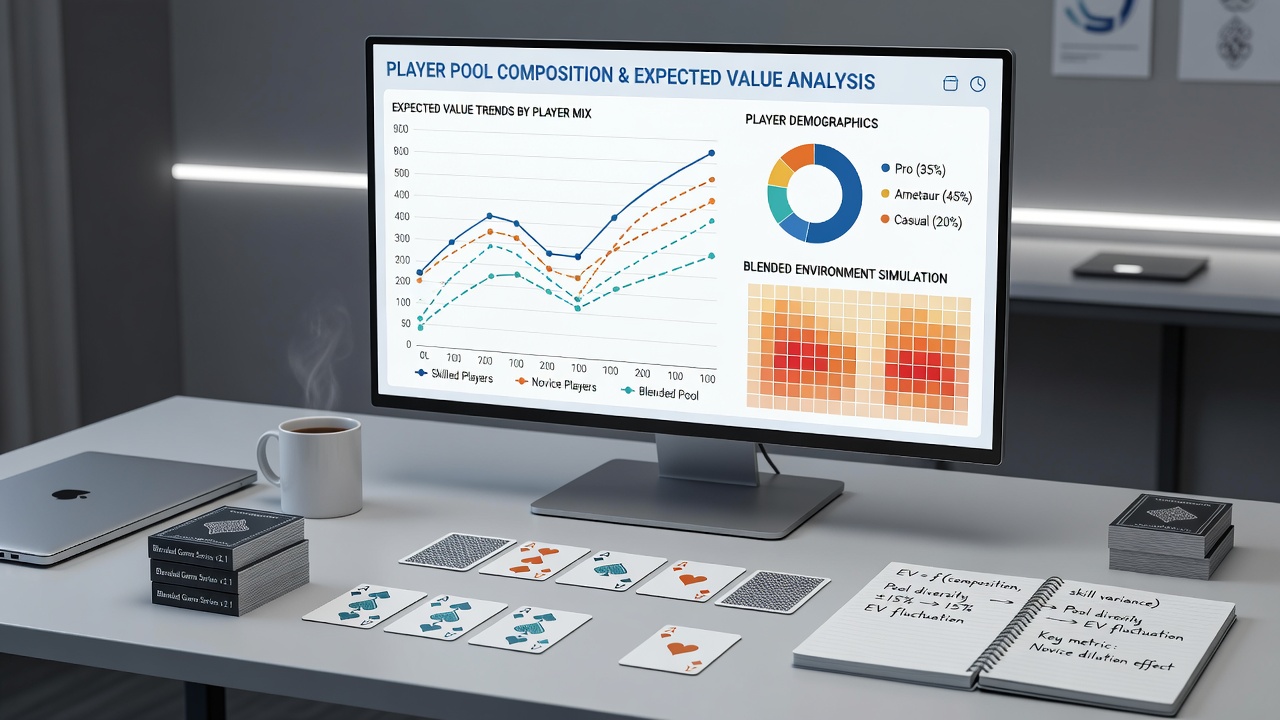
Industry reports from the Nevada Gaming Control Board have catalogued how pool composition interacts with table minimums and maximums, noting that lower-limit areas attract wider style distributions that in turn modify the precision of probability assessments performed by participants. Those who monitor these environments over extended periods observe that sudden influxes of conference attendees or event-driven visitors create temporary imbalances that resolve once the transient group departs, returning the pool to its baseline composition.
Modeling Approaches and Observed Outcomes
Academic teams have constructed simulation frameworks that isolate pool composition as the independent variable while holding game rules constant, and results consistently show that expected value surfaces flatten or steepen depending on the variance introduced by heterogeneous participant groups. One study released through a Canadian research consortium tracked over 50,000 hands across blended formats and confirmed that pools containing balanced ratios of recreational and professional players produced narrower confidence intervals around mean returns compared to imbalanced samples.
Regulatory filings from multiple jurisdictions further support teh finding that pool dynamics influence not only individual results but also aggregate revenue metrics reported by operators, since participation rates and average bet sizes respond directly to the visible skill distribution at active tables. These patterns hold across both physical and virtual blended environments where matchmaking algorithms attempt to replicate natural pool compositions.
Conclusion
Evidence gathered from regulatory bodies, academic institutions, and venue operators demonstrates that player pool composition functions as a measurable determinant of expected value distributions in blended card game environments. Continued collection of granular data across regions will allow for refined models that account for seasonal fluctuations and demographic shifts without reliance on interpretive assumptions.